Custom Residential Smart Home Specialist

Smart Home
Engineering.

A 1,400-entity Apple-grade home in London — designed, built, and commissioned end-to-end. Whole-home integration across lighting, climate, AV, energy, and security.

Try a scene →

3610 K · daytime balance

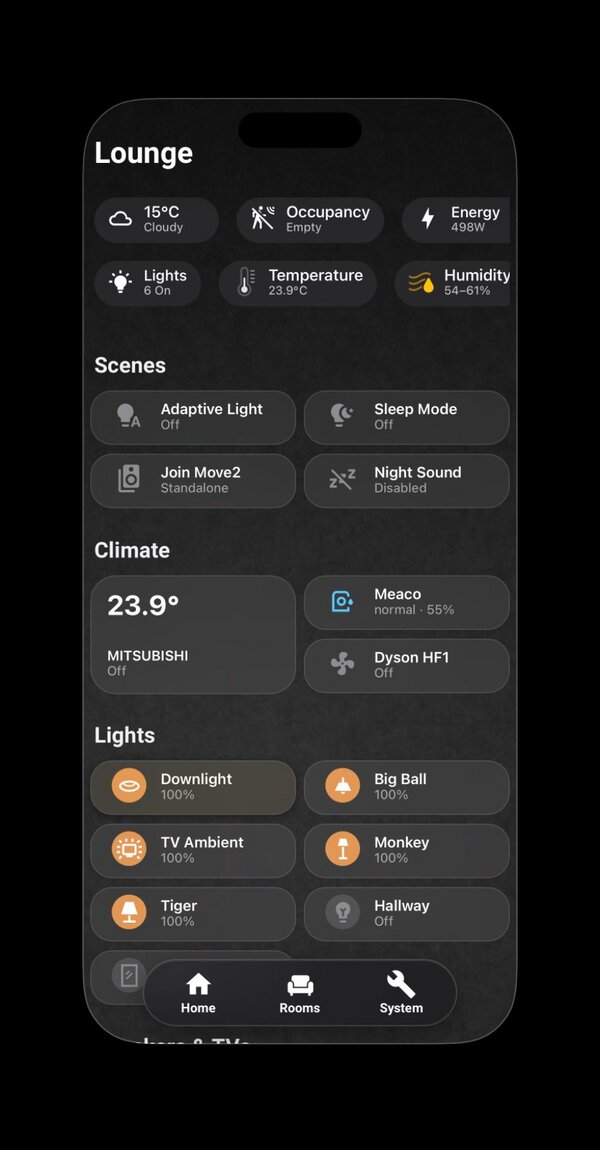
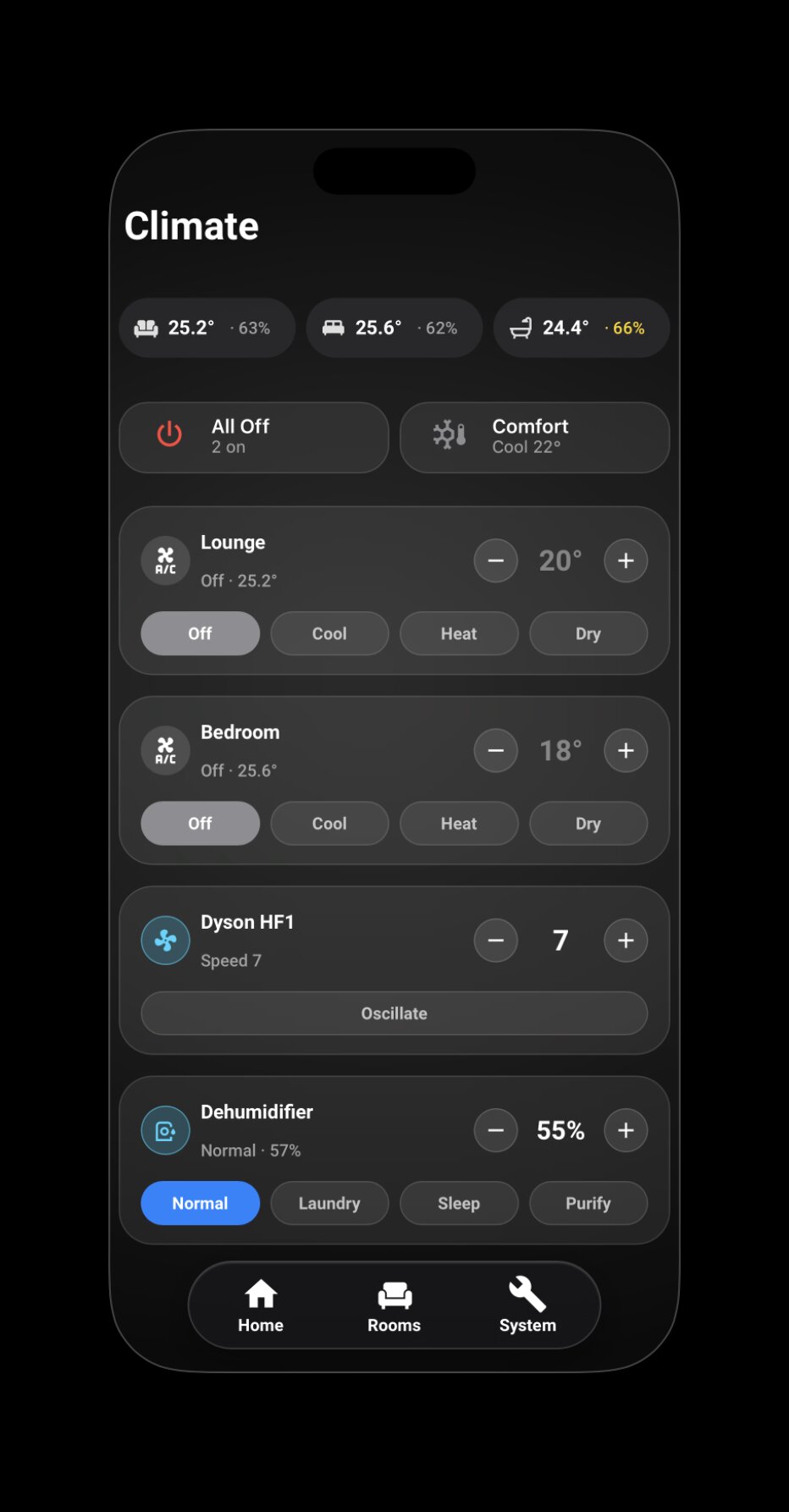
Lounge view of the dashboard, showing climate, scenes, and tunable-white lights

At a Glance

What this project is, in numbers.

A self-directed project built to demonstrate three things relevant to high-end residential integration: that I can think in whole systems, communicate technical decisions in plain language, and deliver to a premium standard of polish.

The Dashboard

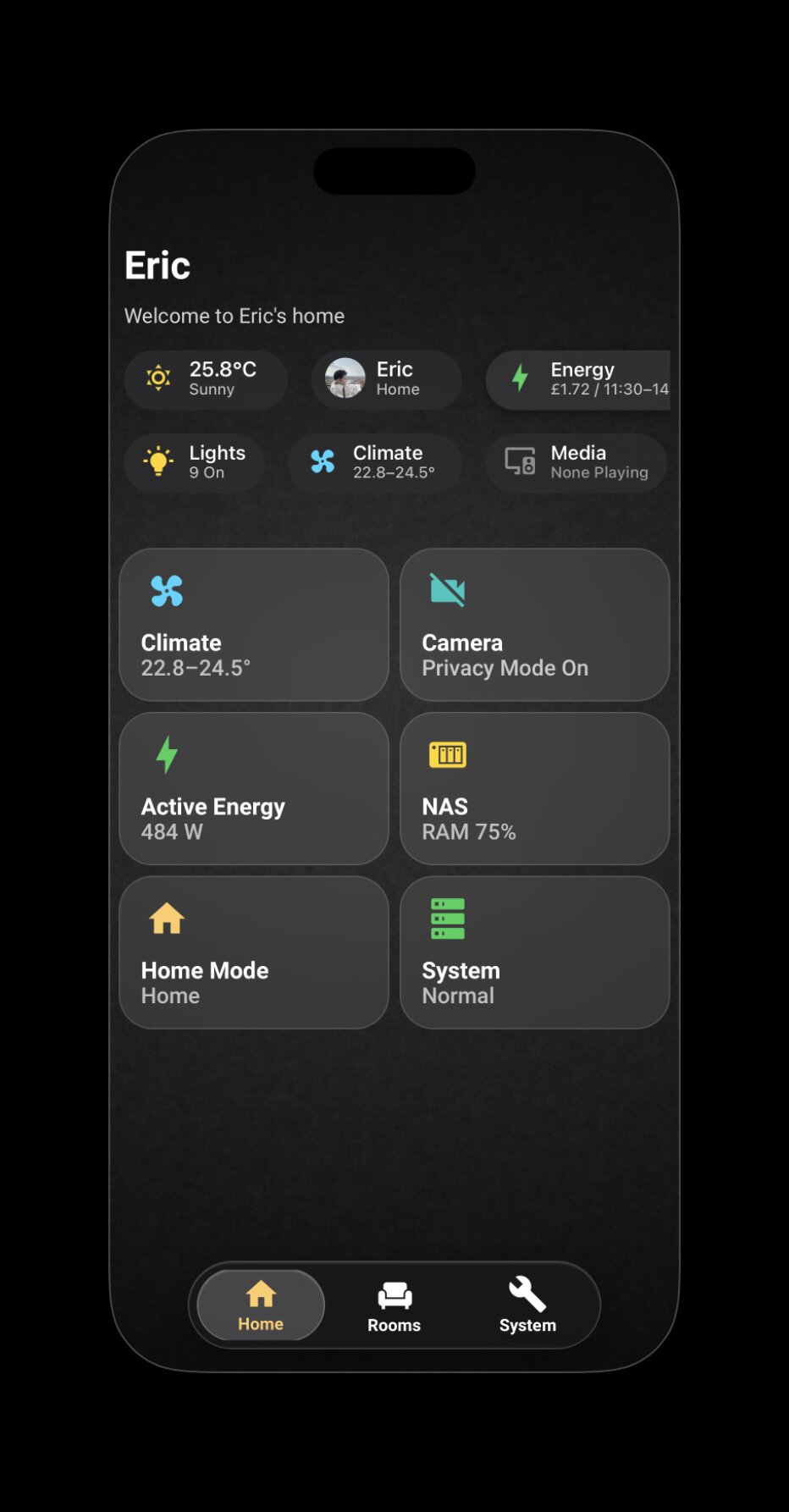
One design language, six rooms.

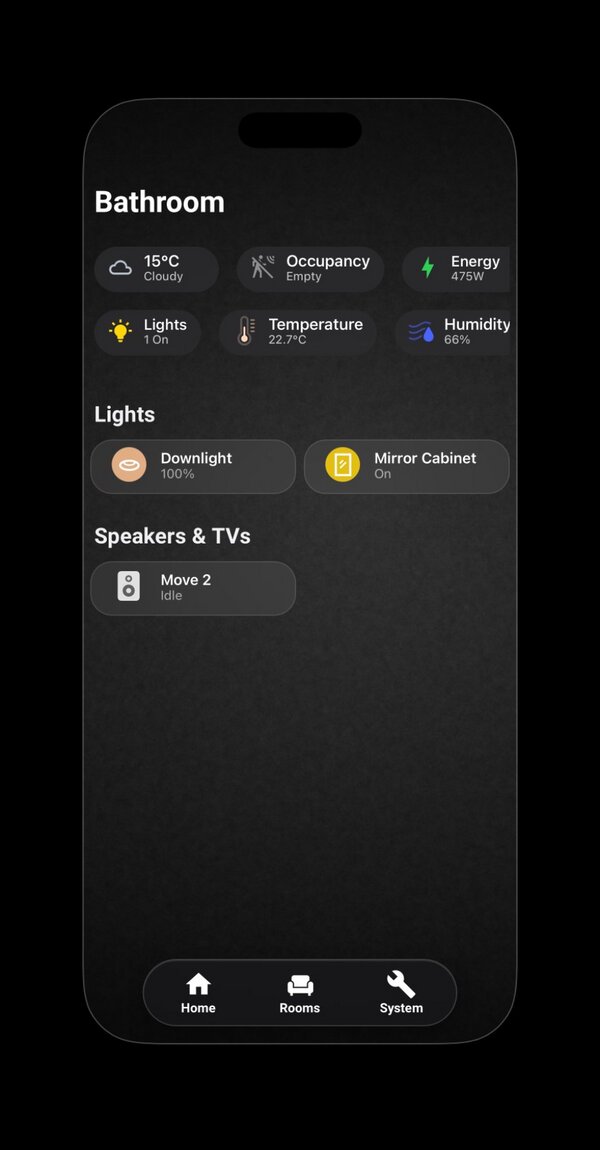
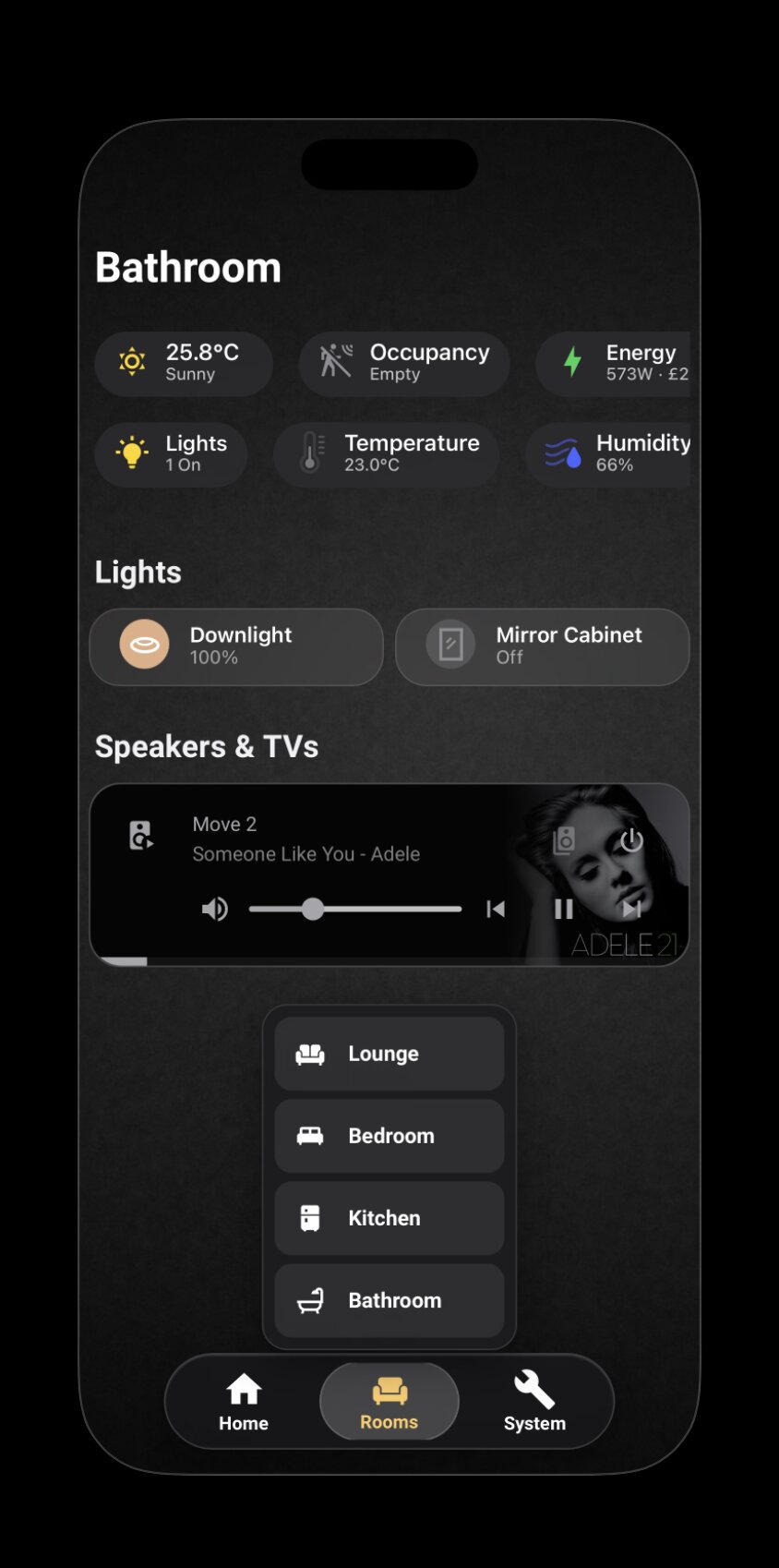
Each room follows the same structure — status bar, contextual controls, fixed dock — but the content respects the room. Kitchen tracks appliances, Lounge centres on media, Bathroom stays minimal.

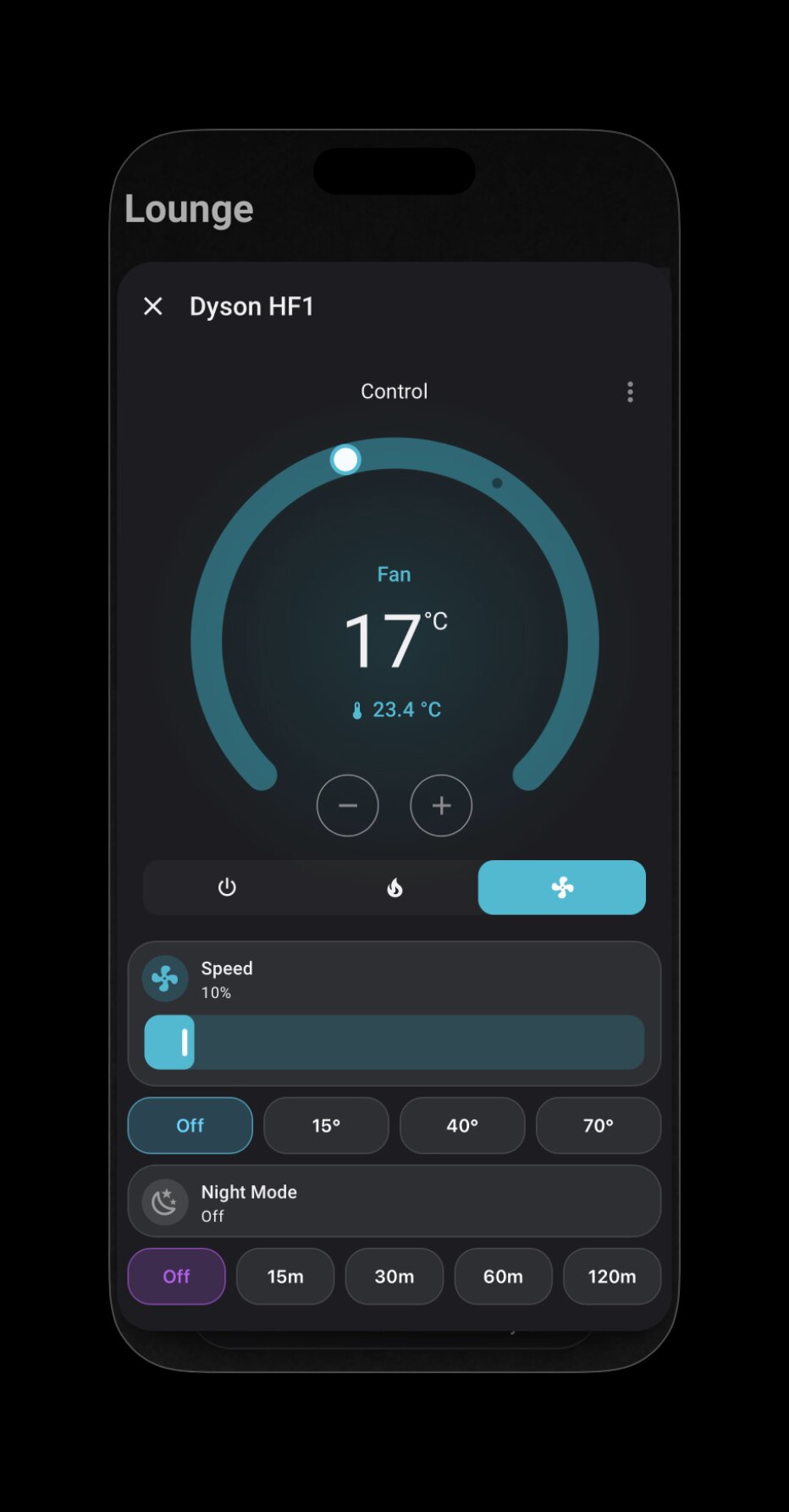
Lounge view
Lounge · Climate, Dyson HF1, six tunable-white lights, media.
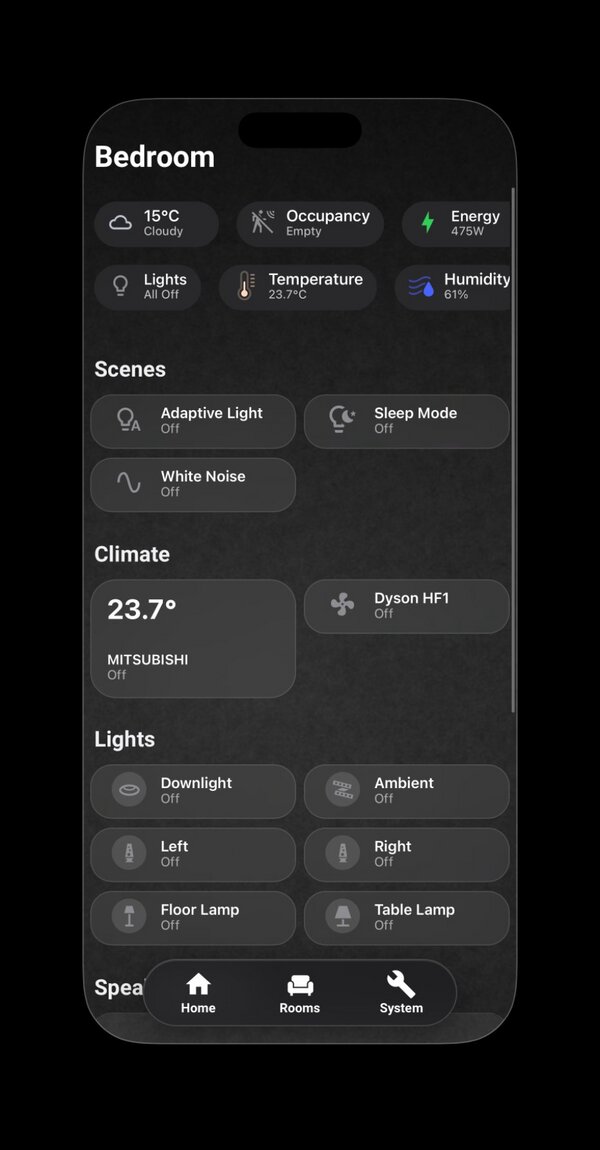
Bedroom view
Bedroom · Bedside lamp control, White Noise scene, AC.
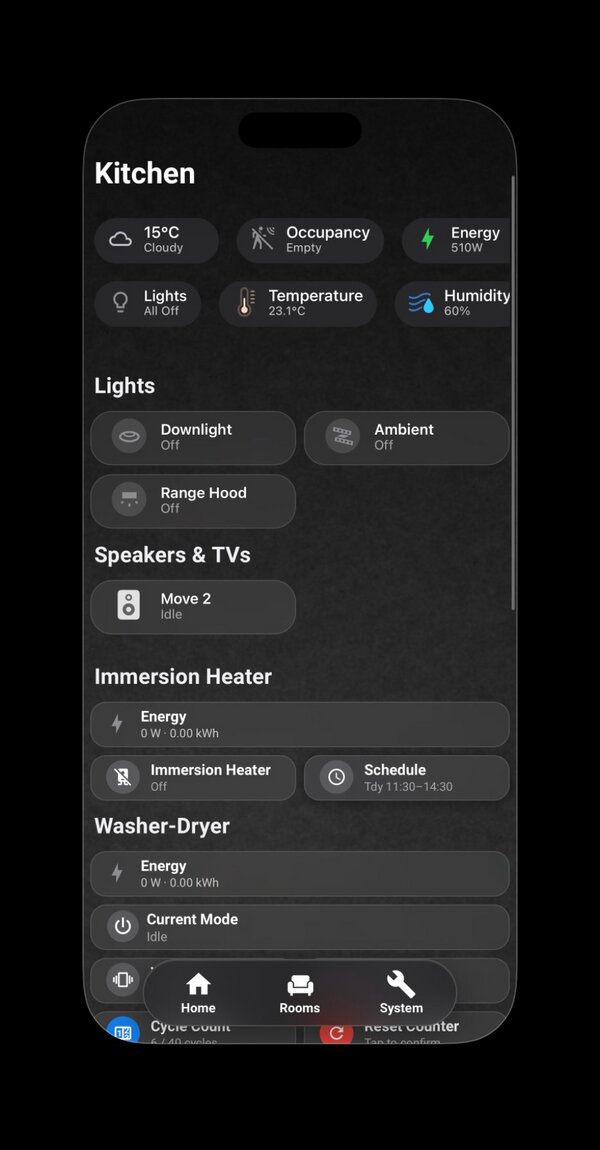
Kitchen view
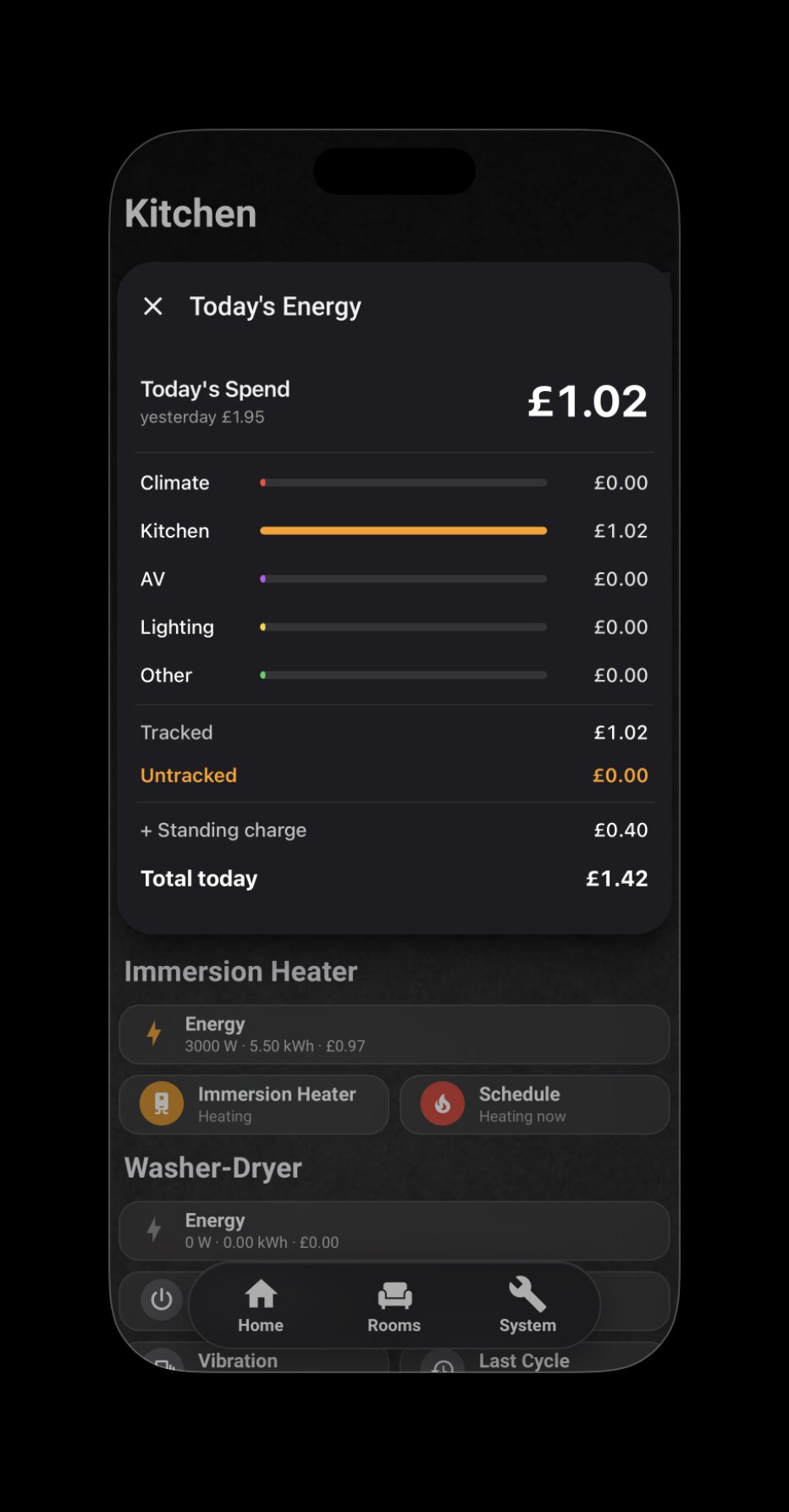
Kitchen · Per-appliance energy, immersion heater scheduling.
Bathroom view
Bathroom · Minimal — the single colour is the one "on" state.
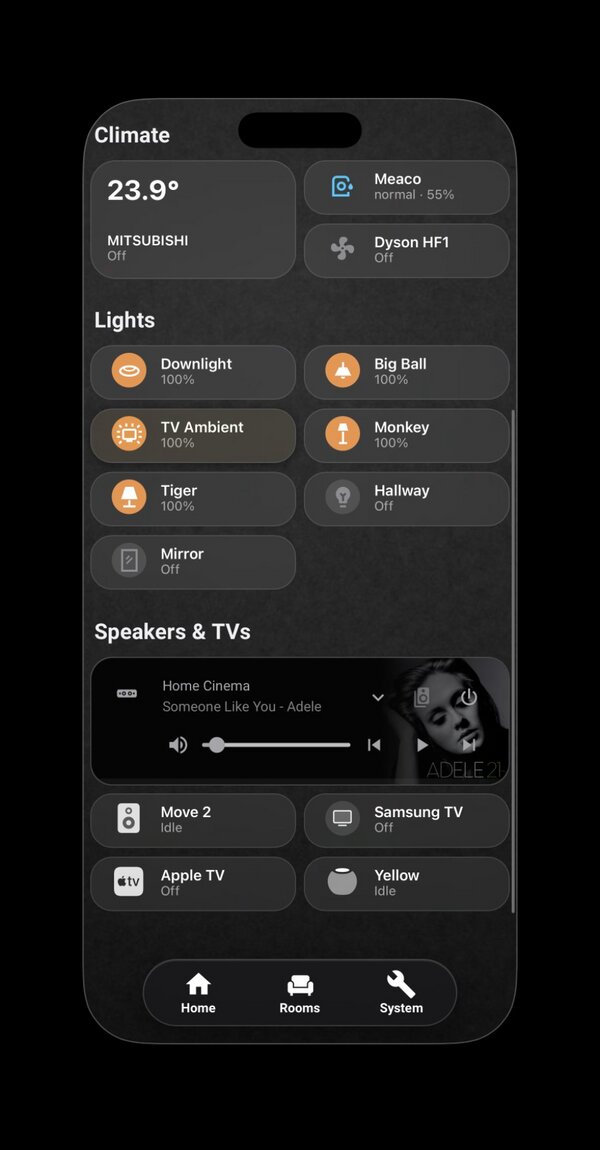
Lounge media section
Media · Sonos Home Cinema, Move 2 grouping, Apple TV.
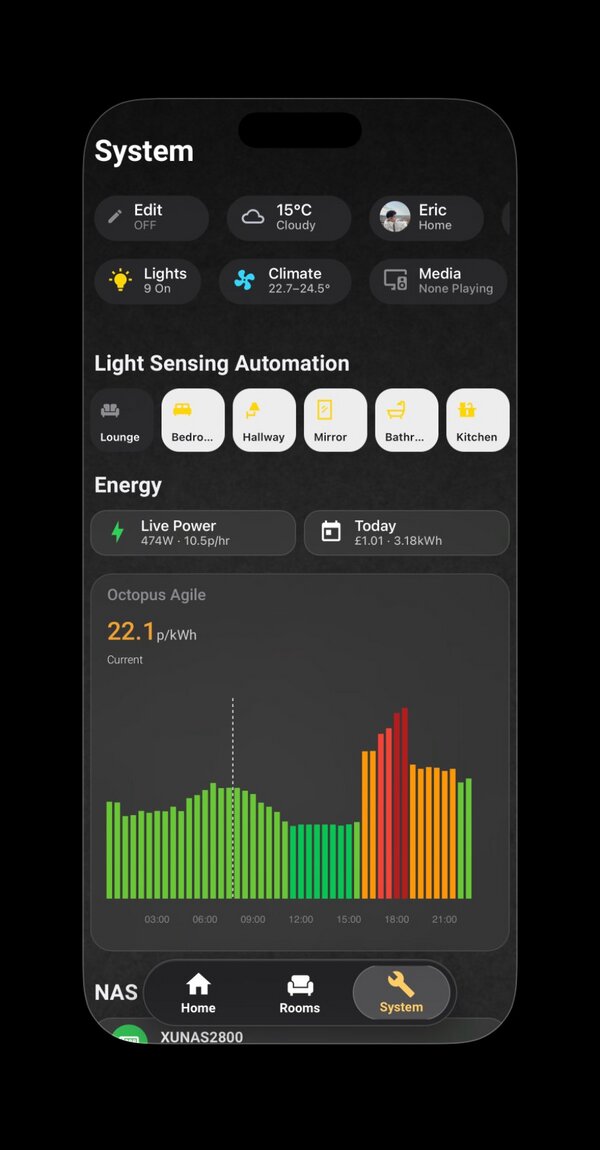
System view
System · Automation toggles, Octopus Agile chart, NAS health.
A Colour is information, not decoration.

Status colours map to Apple HIG semantics — yellow for attention, green for active, red for alert. Lights show their actual RGB output; inactive states are grey. Every coloured pixel earns its place, a discipline that maps directly to commercial lighting scene design.

B YAML over UI clicks.

Every view, automation, and template lives in a version-controlled file — reproducible, diff-able, reviewable. The same engineering standard expected on a commissioning project.

C Native gestures over reinvented controls.

Where Home Assistant's native popups work, I use them. Where they don't, I intervene at the shadow DOM level rather than reinvent the control. The Mitsubishi AC popup was deliberately left native — the engineering cost didn't justify the marginal gain. Knowing when not to build is part of the job.

D Depth visible in the details.

A polished surface earns trust; the details under it earn respect. Powercalc models, Adaptive Lighting curves, shadow DOM fixes — the unglamorous work is documented as evidence, not hidden.

Centerpiece Case Study

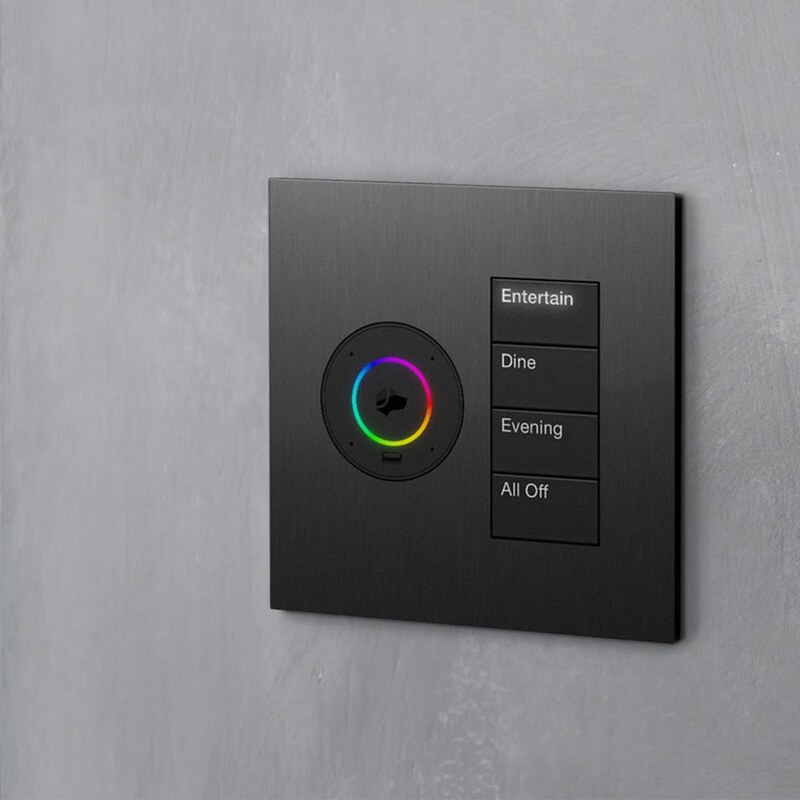
A Lutron-inspired tunable white keypad.

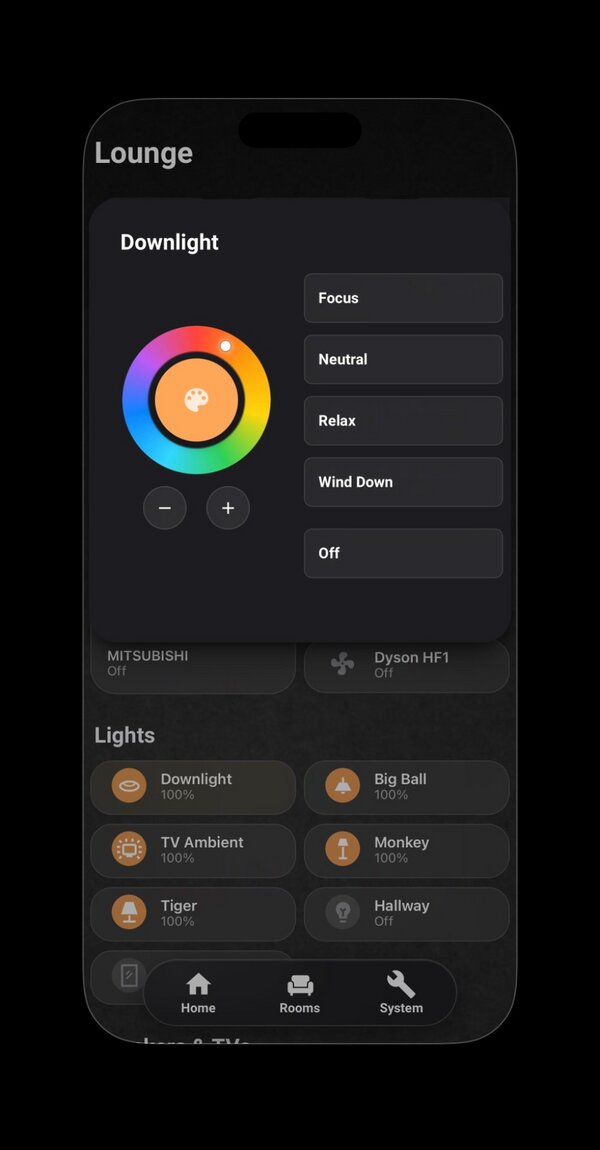
A direct translation of Natural Light principles into a working interface. Five preset scenes spanning the cool–warm spectrum, each bound to a single tap and identified by its own Apple HIG status colour.

Tunable white keypad popup
SceneKelvinPurpose
Focus4440 KCool work light, daylight-equivalent
Neutral3610 KDefault — daytime balance
Relax2710 KWarm evening light
Wind Down2200 KPre-sleep, melatonin-friendly
Off"All Off", Lutron seeTouch-style separator

Conic-gradient colour ring with dual mapping — hue direct, colour temperature mapped to a 20°–55° angular sub-range. The marker position is computed live from the light's color_mode and color_temp_kelvin attributes.

# Each scene binds one Kelvin value; state template detects active scene
- type: custom:button-card
  template: keypad_btn
  name: Focus
  tap_action:
    action: call-service
    service: light.turn_on
    service_data:
      color_temp_kelvin: 4440
  state:
    - operator: template
      value: |
        [[[ return entity.state === 'on' &&
            Math.abs((entity.attributes.color_temp_kelvin || 0) - 4440) < 100; ]]]
      styles:
        card: [{ background: 'rgba(255,214,10,0.15)' }]
        name:  [{ color:      '#FFD60A' }]

Case Study

Half-hourly pricing, modelled and acted on.

Octopus Agile pricing chart
  • Dynamic pricing, live LIVE

    The UK has half-hourly wholesale electricity pricing (Octopus Agile). I integrated the API to expose 48 forward prices, and built a template sensor that computes the cheapest 3-hour window in the next 24 hours — directly usable as an automation trigger.

  • Whole-home modelling

    Devices without their own meter (hob, oven, fridge, immersion heater) are modelled via Powercalc, then reconciled against the Hildebrand Glow CAD whole-home measurement for drift detection.

  • Load shifting

    The immersion heater runs only inside the cheapest 3-hour window each day, scheduled by automation rather than a fixed timer.

  • Local-first metering

    Glow CAD over MQTT gives 10-second whole-home power, with the full SMETS2 dataset available to the automation layer — no third-party cloud dependency.

Real-World Diagnostic

When the telemetry didn't add up.

Eight months into occupancy, the baseline power never dropped below ~570 W — even with every controllable load off. Here's what happened next.

  1. Sep 2025

    Move-in. Baseline starts logging.

    Whole-home power monitored via Hildebrand Glow CAD from day one.

  2. Dec 2025 – May 2026

    The pattern hardens.

    Idle baseline persistently 500–600 W. Bills consistently higher than modelled. All known loads accounted for; the gap remains.

  3. May 2026

    Total Isolation Test.

    Hot-swapped the gateway and router onto a UPS to keep telemetry live, then cut the property's main breaker. Power should have read zero. It read 5.2 kW — proof an upstream circuit was billing this meter for an adjacent flat's HVAC.

  4. Jun 2026 — early

    Telemetry-led dispute.

    Quantified eight months of overcharge (£487 net) from half-hourly settlement data. Evidence pack circulated to Octopus Energy's senior team and the freeholder simultaneously.

  5. Jun 12 2026

    £850 settlement closed.

    Ex-gratia settlement signed. A separate BS 7671 compliance concern (an HVAC circuit bypassing the main isolation switch) was rectified as part of the remediation.

What this demonstrated

System-level diagnostic thinking — designing a controlled test that isolated the variable, not just reading a sensor. Using technical data as commercial leverage in a stakeholder negotiation. End-to-end ownership from anomaly to settlement, closed in 27 days.

Under the Hood

Automation logic.

Sixty-plus automations run the home. A few that show the level of logic involved.

Multi-sensor presence inference (Bathroom)

PIR for instant trigger, mmWave for presence maintenance, plus a cross-zone occupancy-exclusion template that infers bathroom occupancy from recent activity elsewhere in the home — with a 30-minute fallback timeout so lights never stay on indefinitely. Four trigger paths handled in one mode: restart automation.

Washer-dryer state machine

A vibration sensor drives a multi-stage state machine: double-shake confirmation to filter transient noise, a 20-minute refractory period to skip internal baseline cycles, and a debounced 5-minute checkout to detect true cycle end. On completion, it increments a cycle counter and fires a predictive-maintenance alert at 40 cycles.

Energy-arbitrage notifications (Octopus Agile)

When wholesale prices turn negative, an automation parses the API's forward window, applies a 2-minute debounce to filter transient dips, and pushes a notification telling me exactly when the negative-price period ends — so high-draw appliances can be run while being paid to consume.

Tech

Built with.

Smart Building & Lighting

KNX (ETS6) · Adaptive Lighting · tunable white scene logic · Lutron-style keypad UX · Apple HomeKit

Home Assistant Layer

Home Assistant Core · YAML · Lovelace Sections · button-card · card-mod · browser_mod · Mushroom · ApexCharts

Protocols & Integrations

Zigbee2MQTT · MQTT (Mosquitto) · SmartIR · Broadlink IR · Sonos · Music Assistant · Octopus Energy API · Hildebrand Glow CAD (SMETS2) · Powercalc · Cloudflare Tunnel

Infrastructure

UGREEN NAS (Ubuntu VM) · Docker · Eaton UPS via NUT · GitHub · VS Code · Chrome DevTools (shadow DOM)